St. Andrew’s Church in Bandra stands quietly by the sea, yet its story is anything but quiet. The parish dates back to 1575, which makes it older than the Taj Mahal. That alone pulls you in, but the real charm lies in its lived history, serene atmosphere, and timeless coastal setting.
Step inside and you feel the shift. The light softens. The arches echo the early Portuguese style. The old wooden pews still carry the scent of polish and prayer. Outside, sea wind moves through the grounds and the centuries-old cross of Santa Anna stands as a reminder of another lost chapel.
For travellers, heritage lovers, or anyone exploring Bandra’s soul, this church offers a calm, grounding pause. This guide helps you experience it the right way — with history, architecture, and practical tips wrapped into one easy read.

Why Visit St. Andrew’s Church in Bandra
St. Andrew’s isn’t just another church. Here’s why it deserves a spot on your Bandra itinerary:
- Oldest church in Mumbai – Dating back to 1575, it predates many of the city’s landmarks.
- Heritage architecture – Portuguese-inspired arches, wooden pews, and timeless stained glass.
- Peaceful interiors – A calm, reflective space away from the city’s chaos.
- Christmas hotspot – The church glows with festive decorations every December.
- Photography dream – Every corner, from facades to pews, offers a perfect shot.
- Attached cemetery – A quiet, historic resting place with centuries-old tombs.
- Ties to the older Santa Anna church – A surviving cross connects it to a demolished heritage chapel.
History of St. Andrew’s Church
To understand St. Andrew’s Church, we go back to 1534. At that time, Mumbai was an archipelago of seven islands.
The church stands on Salsette Island, just north of these islands. The name “Salsette” comes from the Marathi word Sashasti, meaning sixty-six — a reference to the 66 villages on the island, inhabited by farmers, artisans, and fishing communities.
By the 15th century, many colonial powers had arrived on India’s west coast, including the Portuguese. In 1568, Portuguese Jesuits took control of Bandra. Their early evangelical mission had limited success until Brother Manoel Gomes, the Apostle of Salsette, arrived. He gained trust by respecting local customs and traditions.
In 1575, the church was built to serve Bandra’s growing Catholic population. By 1580, 2,000 villagers were baptized, and by 1603, the entire Bandra population had embraced Catholicism.
The Church of Santa Anna
While St. Andrew’s Church is one of Mumbai’s oldest churches, it is not Bandra’s first parish church. Before it, the Portuguese built a small church and a boys’ boarding school near Bandra Creek in 1574.
In 1739, the British demolished the church, as a part of their strategy, to keep it from falling into the hands of the Marathas.
St. Andrew’s Church, however, remained untouched because of it’s low-key location. For decades, it served as the only parish church in Bandra, witnessing the rise and fall of the Maratha Empire and the gradual establishment of other churches like St. Peter’s and St. Stephen’s Church.

However, only one relic survived: the Cross of Santa Anna, now standing within St. Andrew’s compound. It is now the oldest Cross in Mumbai.
Carved from a single stone, the cross is adorned with intricate Christian icons, silently preserving the memory of a lost parish.
The Architecture
One of the first things visitors notice at St. Andrew’s Church is the graves surrounding the churchyard, adding a sense of history to its Portuguese-style design.
The main gate also has the diagonal cross referencing St. Andrew.
Over the years, the building has undergone several repairs, preserving its charm while maintaining structural integrity.
In the compound stands the monument of Christ the King, erected in 1935, a subtle highlight among the greenery.


The church façade features a round aperture facing east, welcoming morning sunlight into the nave. Twin towers flank the front, each rebuilt over time, adding symmetry and grandeur to the structure.
Inside the Church – What to Expect
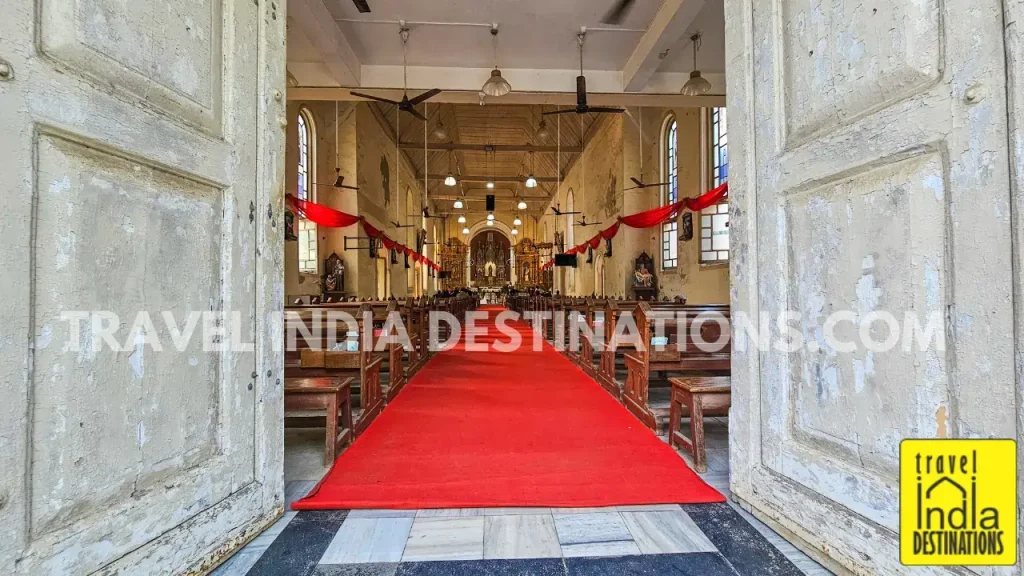
Stepping inside St. Andrew’s Church, you’re greeted by a calm, serene atmosphere. The air feels hushed, punctuated by soft footsteps and quiet prayers.
The seating layout is simple yet elegant, with long wooden pews aligned to face the towering teakwood altar.
The lighting is gentle, streaming through stained-glass windows, creating colorful patterns on the floors and walls.


Inside, stained-glass windows line the sides, bathing the interior in soft, colorful light throughout the day.
The teakwood altar, built in 1906, rises to the roof, with Saint Andrew at the center, the Sacred Heart on the left, and Our Lady of the Navigators on the right.
Above them, smaller statues of St John the Baptist, St Sebastian, and the Bom Jesus complete the devotional ensemble.
The prayer area near the altar allows devotees to kneel or stand quietly, offering personal reflections.
Visitors should respect the dress code: modest attire covering shoulders and knees is expected.
Finally, follow basic etiquette, speak softly, avoid touching sacred objects, and refrain from using flash photography inside the church. These simple gestures ensure a respectful and immersive experience.
The Cemetery
The cemetery at St. Andrew’s Church is a quiet, reflective space tucked on the side and behind the main building. Its significance lies not just in its age, but in the stories each tomb tells about Bandra’s past.


Many of the tombs date back centuries, with inscriptions in Portuguese and English, offering glimpses into the lives of early settlers, priests, and parishioners.
These carvings make it a photography hotspot, though visitors should avoid stepping on graves or leaning on monuments.
Respectful behavior is key: speak softly, maintain distance, and never disturb the resting places. Photography is allowed, but keep flash and large setups to a minimum.
The cemetery is open daily:
- Morning: 7:00 AM – 2:00 PM
- Evening: 4:00 PM – 8:00 PM
Visiting Guide
| Mass Timings | Weekdays: 7:00 AM, 8:00 AM, 7:00 PM Sundays: 7:00 AM, 8:15 AM (Children’s Mass), 9:30 AM, 6:00 PM Youth Mass: 4th Sunday of every month at 10:30 AM |
| Best Time to Visit | Morning: 10:00 AM for soft sunlight through stained glass Evening: 5:00 PM for calm atmosphere and golden light on the façade |
| How to Reach | Train: Bandra Station (local trains) Bus: Routes A-211, A-214, and A-219 run from Bandra West to St. Andrew’s Church Rickshaw: Quickest way to reach directly in front of the church |
For updates and schedule changes check the church’s official website.
Places to See Nearby
While visiting St. Andrew’s Church, you can explore several nearby spots:
- Bandstand: A scenic seaside promenade perfect for a stroll or sunset photography.
- Mount Mary Church: Just a short walking distance away, you can visit the iconic Mount Mary Church Bandra, which is among the popular churches in Mumbai.
- Hill Road: Bustling street with shops, cafes, and local flavour. This street transforms into one of the best Christmas markets in Mumbai, if you plan some Christmas shopping.
- Linking Road: This one is famous for street shopping in Mumbai, combined with street food, and vibrant energy, ideal for a post-church exploration.
These nearby attractions make it easy to turn a single church visit into a half-day or full-day Bandra experience.

Final Thoughts: Visiting St. Andrew’s
St. Andrew’s Church in Bandra is more than a centuries-old building. It is a living piece of Mumbai’s history blending Portuguese architecture, hidden relics, and serene spaces which invite quiet reflection.
Among the famous churches in Mumbai, St. Andrew’s stands out. It is a parish where history and community meet.
From the Santa Anna Cross to the teakwood altar and the peaceful cemetery, every corner tells a story.
Whether you love heritage architecture, festive Christmas vibes, or photography, this iconic church delivers. You can pair your visit with another church in the vicinity or enjoy sunset experience at Bandstand, or go street shopping for a full Bandra experience.

8 comments
This is a wonderful tour, Sharukh. All the intricate work on the alter and pulpit is amazing. Thanks for all the history. Sharing.
Hugs.
Thank you, Teagan for sharing it on your account. Hugs. Glad you enjoyed the virtual tour.
Thanks for the lovely tour of St Andrew’s Church, Sharukh. Thanks, too, for including the cemetery guard at the end 🙂 One of the things I always notice in the photos is the presence of overhead fans. I guess that’s a condition of the climate.
Overhead fans are everywhere in India. The cemetery guard (cat) kind of scared me. I was too busy scanning the graveyard horizon thinking what to capture on my camera and there he/she was just three yards from me, staring at me. Maybe he/she was saying – Won’t you want to click my picture? So, I took a picture and decided to include in the post. Glad that you enjoyed the tour. Another church coming up next Thursday.
A lovely church, Sharukh. I understand the use of overhead fans. We like to have them here in Arizona, too. No humidity but plenty of heat. 🙂
janet
Glad that you enjoyed the church tour, Janet. Mumbai is more like Miami in terms of weather but has a vibe of NYC, LA and Philly combined. I mean that’s my opinion.
“Housewife” is also a profession, no? Seriously. …
Lakshman G, I believe being a housewife is more than a profession. In a job, the employee has fixed working hours, perks and all that. On the other hand, managing a house is a full-time task and I give credit to Sarah for all the work she does.