History, for many of us, was the subject we endured in school, a dry recitation of dates and dusty syllabi. However, the true story of the Maratha Empire isn’t found in a textbook; it’s written in the lightning-fast cavalry charges and the stone ruins of Pune.
While the cinematic world of Bajirao Mastani gave us romance, it barely scratched the surface of the man who was essentially India’s greatest military strategist. Peshwa Bajirao I didn’t just fight battles; he reinvented them.
In this guide, we strip away the Bollywood filter to look at this Maratha warrior who fought 41 major combat engagements and remained unbeaten. This is the history you were never taught and barely showcased on celluloid.
The Maratha Blueprint: A Quick Context
To understand Bajirao, one must understand the dream of Hindavi Swaraj (Indian Self-Rule). Championed by the empire’s founder, Chhatrapati Shivaji Maharaj, this wasn’t just a military movement; it was a total rejection of foreign sultanate influence.
By 1713, the empire had transitioned from a rebellion into a structured power under Chhatrapati Shahu. But it was the Peshwas, the Chief Executives or Prime Ministers, who turned this local resistance into a subcontinent-defining force.
What does ‘Peshwa’ actually mean?
In the 18th-century Maratha court, the Peshwa was the Chief Executive or Prime Minister. While the Chhatrapati was the sovereign King, the Peshwas controlled the state administration, appointed generals, and led the diplomatic charge. They were the engine room of the empire.
1720: The Rise of a 20-Year-Old Genius
When Peshwa Balaji Vishwanath passed away in 1720, the Maratha court was at a crossroads. His son, Bajirao Ballal Balaji Bhat, was only 20 years old. To the veteran generals, he was an untested youth. To Chhatrapati Shahu, he was the future.
Bajirao hadn’t spent his youth in the palace; he had spent it in the saddle alongside his father. He understood the terrain, the diplomacy, and the simmering weakness of the Mughal Sultanate.
Chhatrapati Shahu’s decision to appoint him wasn’t just a favor to a loyal family, it was a calculated gamble on a new generation of warfare.
The Invention of “Lightning Cavalry”
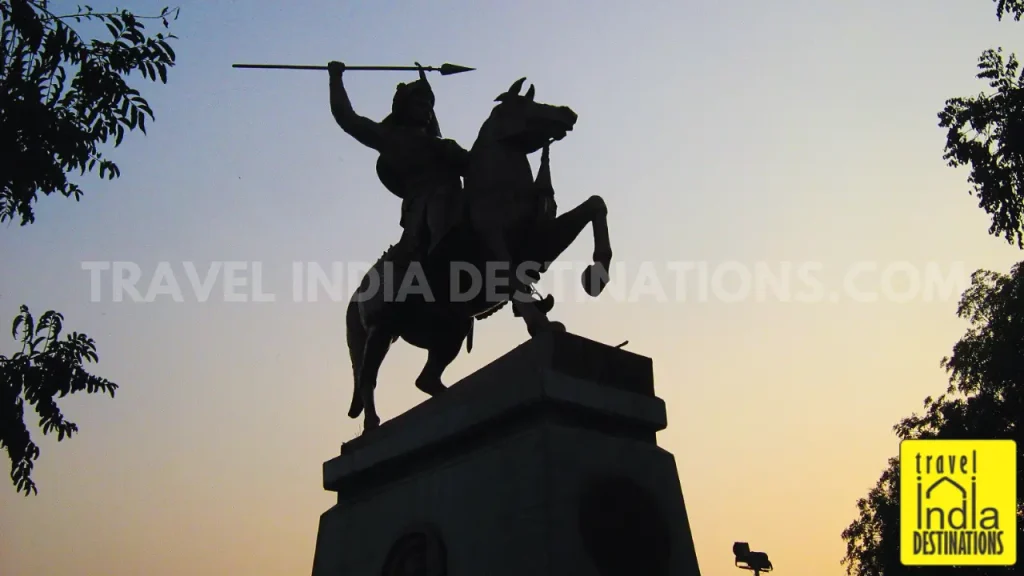
One of the reasons that made Bajirao I a ‘Killing Machine’ is his total rejection of traditional Indian warfare.
While the Mughals and other regional kings moved with the tectonic slowness of heavy artillery, massive food supplies, and royal tents carried by elephants, Bajirao stripped his army down to its deadliest essence: The Lightning Cavalry.
This strategy revolutionized warfare in a way the Mughals had never anticipated. Bajirao and his soldiers carried no heavy baggage. They lived off the land and slept with their horses.
This nimbleness allowed the Marathas to strike out of the blue, cut enemy supply lines, and vanish before the opposing army could even deploy their cannons. He didn’t just fight his enemies; he exhausted them.
The Malwa Campaign & Amjhera
By 1723, Bajirao set his sights on Malwa, the strategic gateway to Central India. Alongside his brother, Chimaji Appa, he orchestrated a campaign that shifted the Maratha frontier.
The climax came at the Battle of Amjhera on November 29, 1728. Facing a Mughal force that relied on superior numbers, the Marathas executed a high-speed maneuver that overwhelmed the Mughal commanders before they could stabilize their front. This wasn’t just a win; it was a signal that the Marathas were now the tax-collecting authorities of the North.
The climax came at the Battle of Amjhera on November 29, 1728. Facing a Mughal force that relied on superior numbers, the Marathas executed a high-speed maneuver that overwhelmed the Mughal commanders before they could stabilize their front.
This wasn’t just a win; it was a signal that the Marathas were now the tax-collecting authorities of the North.
The Bundelkhand Rescue
In 1728, when the Mughal general Muhammad Khan Bangash besieged Bundelkhand and imprisoned the aging Raja Chhatrasal, the Raja sent a desperate plea to Bajirao. The Peshwa didn’t hesitate.
He galloped across the terrain with such speed that he caught Bangash completely off-guard, forcing a total Mughal retreat.
In gratitude, Chhatrasal treated Bajirao as his own son, granting him a third of his kingdom and the hand of his daughter, Mastani. While history remembers their romance, the alliance was a geopolitical masterstroke, firmly planting the Maratha flag in the heart of Bundelkhand.
The Masterpiece at Palkhed
If you want to see Bajirao’s genius in a single event, look at the Battle of Palkhed. The Nizam of Hyderabad, a seasoned veteran, attempted to play a game of thrones by supporting a rival Maratha faction. He marched with a massive, artillery-heavy army, expecting a head-on collision.
Bajirao did the opposite. He refused to defend his capital. Instead, he led the Nizam on a wild goose chase across the Deccan.
By the time the Nizam realized he was being lured into the waterless, rugged terrain near Palkhed, his heavy cannons were useless and his men were starving.
Without firing a single major artillery shot, Bajirao forced one of the most powerful men in India to sign a humiliating treaty. It was a victory of intellect over iron.
The Phantom Raid of Delhi
In March 1737, Bajirao did the unthinkable: he took the war to the gates of the Mughal capital. While the Mughal generals were busy celebrating a supposed victory over a small Maratha contingent, Bajirao executed a ten-day march in just forty-eight hours.
He appeared at the Talkatora outskirts of Delhi, sending the imperial court into a frenzy of panic. He didn’t capture the city, he didn’t need to.
By looting the outskirts and defeating the local cavalry, he proved that the Mughal Emperor was no longer safe, even behind his own walls. He shook the foundation of the empire with his ‘Phantom‘ presence.
The Siege of Bhopal
The final nail in the coffin of Mughal supremacy was the Battle of Bhopal. The Emperor had summoned the combined forces of the Nizam, the Rajputs, and the Nawabs, an army of nearly 200,000.
Bajirao, with a much smaller force, used his trademark encirclement strategy. He trapped the massive Mughal host inside the Bhopal fort, cutting off every supply line. For a month, the grand army of the Mughals faced starvation.
The resulting treaty of Doraha made the Marathas the undisputed masters of Central India. Bajirao had moved the Maratha frontier from the Deccan to the doorstep of the Himalayas.
The Base of Operations: Shaniwar Wada
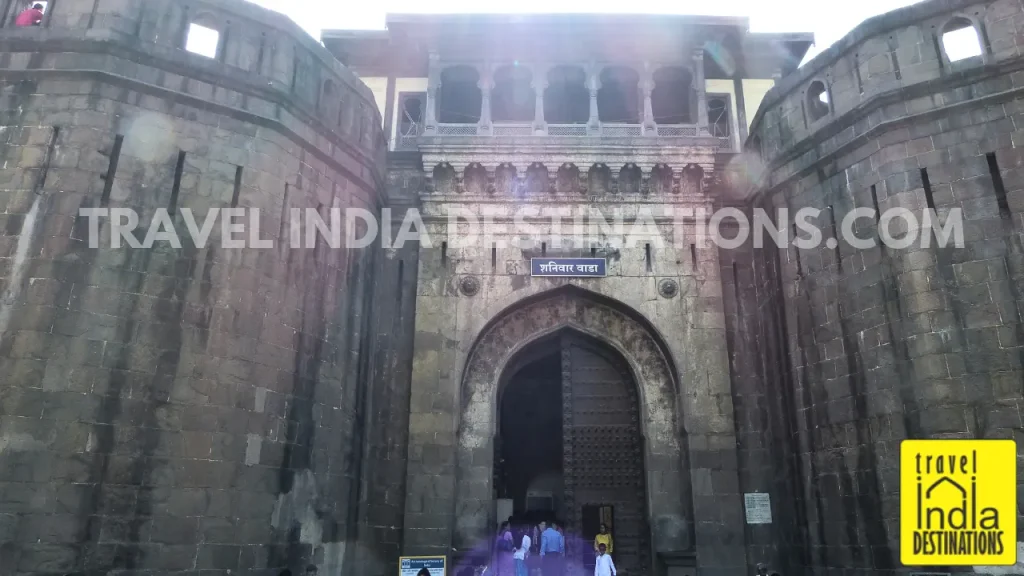
In 1728, Bajirao moved the Maratha center of power from Saswad to Pune, a move that would transform a small market town into a geopolitical capital.
He commissioned the construction of Shaniwar Wada, the “Saturday Residential Complex“, which was completed in 1732.
Though much of the seven-story palace was lost to a mysterious seven-day fire in 1828, the stone foundations and formidable gates remain as a testament to the Peshwa’s strategic mind.
The Architecture of Defiance
While the palace was built for luxury, its exterior was built for war. The complex is defined by its five massive gates, but one stands above the rest.
Dilli Darwaza (The Delhi Gate): Facing north toward the Mughal capital, this gate was a psychological statement of Bajirao’s ambition.
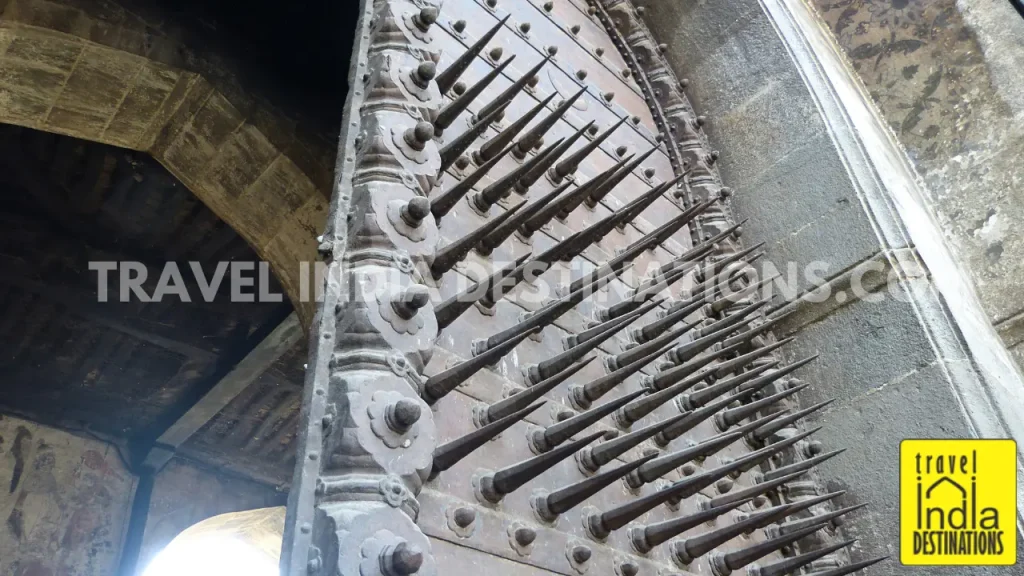
The Elephant Spikes: The main entrance gate has these 72 massive steel spikes, each 12 inches long. These weren’t decorative; they were designed to prevent armored elephants from ramming the gates.
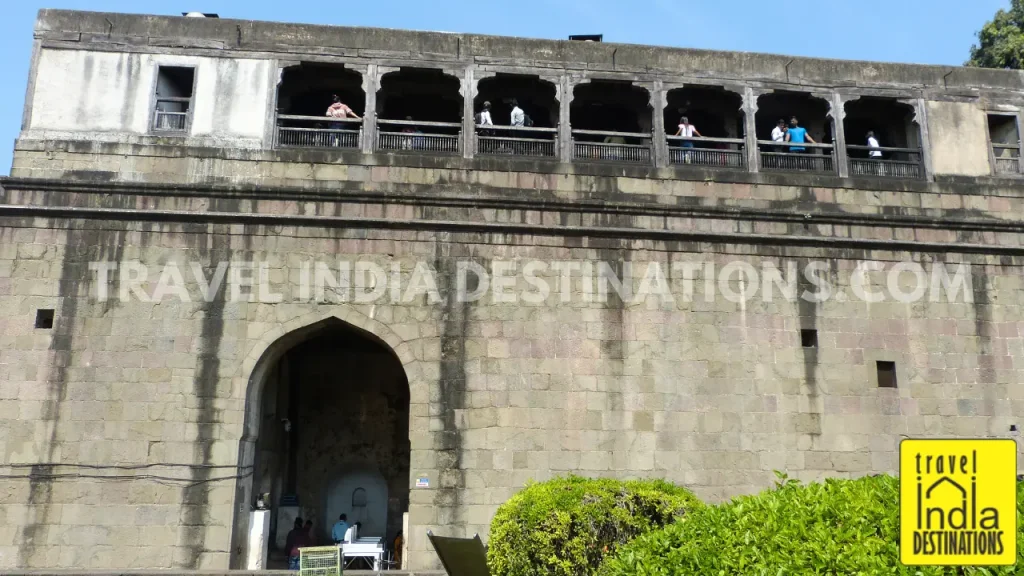
Tactical Entry: The entrance features a sharp right-angled turn. This “staggered” design ensured that even if the gates were breached, the charging enemy would lose all momentum, allowing the defending Marathas to strike from the balconies above.
TID 2026 Visitor Guide:
Timings: 9:30 AM to 5:30 PM.
Entry Fee: ₹20 per person (Indian) | ₹250 per person (International Tourist)
Light & Sound Show: The English show starts at 8:15 PM (Tickets: ₹25). It is the best way to visualize the palace’s former glory.
Photography Tip: Head to the Nagarkhana (Drum House) above the main gate for a panoramic view of the garden complex.
🛡️ Planning Your Visit: Essential FAQs
To really see the fortifications and read the plaques, you need about 60 to 90 minutes. If you are a photography enthusiast, aim for the “Golden Hour” (around 4:30 PM) when the stone takes on a deep orange glow.
Local legend says the ghost of Narayan Rao Peshwa cries out on full moon nights. While the ASI (Archaeological Survey of India) closes the fort at 6:30 PM, the Light and Sound Show at night leans into these legends, making it a fun, atmospheric experience rather than a scary one.
The fort is located in Shaniwar Peth, the “Old City.” The lanes are extremely narrow and traffic is heavy. Do not try to park a car here. Use an auto-rickshaw or a ride-sharing app to drop you at the main Dilli Darwaza.
Actually, his Samadhi is not in Pune. It is located in Raverkhedi, Madhya Pradesh, where he passed away. If you want to pay your respects in Pune, Shaniwar Wada and the equestrian statue outside the gate are the primary landmarks.
Yes, you are in the heart of Puneri cuisine. For an authentic experience, walk 10 minutes to Suvarnarekha or Prithvi for a traditional Maharashtrian Thali. If you’re looking for a quick snack, the famous Misal Pav stalls in the nearby Kasba Peth are legendary.
🚶 Experience the Legend: The Peshwa Trail
Reading about the Maratha Empire is one thing; walking through its power centers is another. If you’re visiting Pune, I highly recommend joining the Pune Cultural Walking Tour.
It starts at the Shaniwar Wada gates we discussed above and takes you through Tulsi Baug and Vishrambaug Wada, the grand residence of Peshwa Bajirao II.
It’s the best way to see the “hidden” architecture of the Wadas that most tourists walk right past.
👉 Book the Cultural Walking Tour of Pune
If you enjoy deep dives into India’s untold history, forts, empires, and forgotten stories, join the TID newsletter.
The Final Sunset: A Legacy in Motion
Bajirao’s life was as fast-paced as his cavalry. On April 28, 1740, at the age of just 39, he succumbed to a sudden fever on the banks of the Narmada River. He died as he lived, on a campaign, in a tent, looking toward the next frontier.
While Chhatrapati Shivaji Maharaj was the founder of the Maratha dream, Bajirao I was the force that made that dream a continental reality. He was the Unbeaten Warrior, a leader who proved that with enough speed and strategic clarity, no kingdom is out of reach.
🎖️ Love Military History? Pune’s warrior legacy didn’t end with the Peshwas. If you want to see how that spirit evolved into the modern day, you may also want take a tour of The Southern Command Museum, just 20 minutes away, which offers a journey through modern warfare.

12 comments
This is a fascinating account of some very important military history. Thanks for the effort. The photos are beautiful. As I was reading this, I thought “this sounds like modern tank warfare strategy” so I searched on that and found that some of these battles were mentioned in Field Marshal Montgomery’s book on warfare. He was Britain’s greatest tank commanders.
Yeah. Many of Bajirao’s warfare tactics have been adopted by various other Indian fighters as well, I’m sure many other people must have taken clues and ideas from his battle strategies and implemented in their own style. So, what do you think of this? Good, Bad, Average, Too Long, Too Intensive. I mean this is the first time I attempted something like this, so not sure if I did it right.
You did a very nice job with this. I love history, I love military history, so I’m an easy target, but this was very easy to read and I enjoyed the pictures and, especially the maps. I think without the maps, and a working knowledge of India geography, I would have been lost.
Thank you Dan. I’m glad you liked it. When I began my research I had to decide what to include and exclude otherwise there would be too much content. Next I had to incorporate the maps because without it even Indian readers won’t understand what I am saying.
While I am not a fan of history as it oertains to wars, conquerers and occupations, I do enjoy knowing the evolution of the populactions and cultures of the world which is, of course, directly affected by this very history. You always do a precisely interesting job of presenting fact with curiosity satsifying tidbits. The photos, as always, as beautifully matched to your content. I only would prefer to be sitting and listening to you tell me this information. Then Sarah and I could visit! Nice job.
Thanks Cheryl for visiting and reading the post. Yeah, I realized from the response that not many of my readers are fond of history, although I tried to make it as interesting as possible with maps and war stories. I will switch back to my regular travel posts which I believe are more loved by readers. Yeah, you can fly to India and then you and Sarah can go strolling the streets and mountains, you both are passionate about nature so you have plenty to talk about. 🙂
And bring our cameras of course! 😊
A detailed account on the wars fought by the Great Bajirao in Maharashtra and all over India. I love the hard work and dedication put in sharing the history:)
Thanks Vishal.
Incredible account of the history and power of this place ~ and the photographs were fantastic. Thank you very much for taking the time to put this together so well, so completely 🙂
Thank you for visiting and reading my post. I’m glad you liked it.
[…] concepts to make my travel blog interesting. Last time, I tried to infuse history with travel in my Forgotten Warriors Lost Kingdom post, but it didn’t get the kind of response I expected. This time I am doing nothing much, but […]